


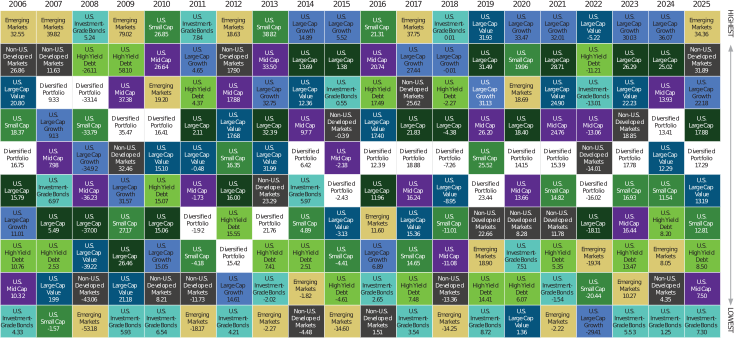
You’ve likely come across a chart like this at some point in your financial planning journey:
What Diversification Is Meant to Do
Advisers often refer to this chart as an asset allocation “quilt.” It illustrates the value of owning a diversified portfolio (the white boxes) rather than concentrating too heavily in a single investment or trying to time the stock market. Since 2006, a diversified 60/40 portfolio has produced a 9.68% annualized return. In contrast, the other colors move sharply up and down, highlighting how difficult it is to predict which asset class will outperform in any given year. This is why diversification matters: by owning a mix of investments at the same time, investors can pursue reasonable long-term returns while reducing the impact of extreme market swings.
When portfolios are thoughtfully diversified, returns tend to land closer to the middle over time. As you scan the chart from left to right, notice how the white boxes appear with relative consistency. That steadier pattern reflects what proper diversification is designed to provide—more balance and a smoother overall experience.
The Hidden Problem With “Being Diversified”
Many people think of diversification as avoiding putting all their eggs in one basket, and that’s a helpful starting point. In practice, however, diversification is often more nuanced. It generally involves gaining exposure to a broad range of companies across different segments of the market.
The challenge is that, in an effort to diversify, investors may unknowingly build portfolios that are more complex or less efficient than they appear.
Not Sure Where to Start?
Begin your journey by meeting with an adviser to talk through your goals. We’ll help you find the right path forward — no obligation, just insight.
When Multiple Funds Own the Same Companies
Here’s what I mean: Suppose you want to include large cap U.S. stocks in your portfolio. You know it wouldn’t be prudent to invest everything in a single company, so you select several mutual funds or ETFs that represent this asset class. At first glance, your portfolio appears well diversified because it holds a variety of investments, you’re not putting all your eggs in one basket, right?
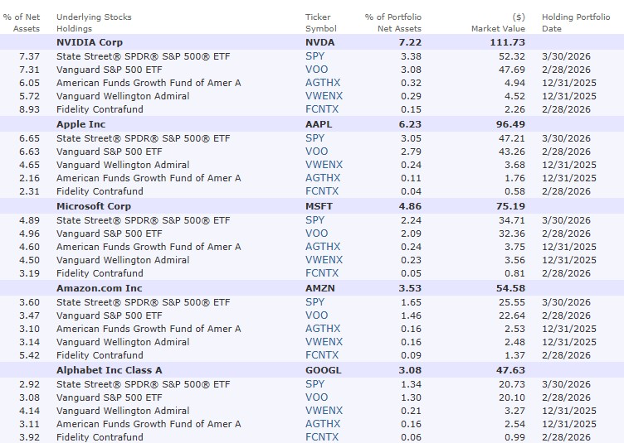
Let’s take a closer look by “x‑raying” a hypothetical portfolio built with five popular large-cap funds.
Why Portfolio Overlap Can Create Inefficiency
Do you see what’s happening here? In an effort to diversify, you may end up owning companies like NVIDIA, Apple, Microsoft, Amazon, and Alphabet multiple times across different funds. These are just a few examples; this type of overlap can be present throughout a portfolio. What initially appears to be diversification may instead reflect unnecessary duplication.
Because each mutual fund or ETF carries its own expense ratio, holding multiple funds with similar underlying investments can increase costs without necessarily improving diversification. Over time, it’s possible to accumulate many funds that hold many of the same companies, adding complexity without a clear benefit.
Diversification Should Focus on Asset Classes
So, what’s to be done? In practice, diversification is often more effective when it focuses on broad asset classes rather than the number of funds held. This means gaining exposure to different market segments and a wide range of underlying companies, rather than relying on multiple funds that may overlap in their holdings.
Investors may benefit from holding a mix of asset classes—such as large‑, mid‑, and small-cap U.S. stocks, international equities, and fixed income—while maintaining a clear understanding of how each investment contributes to the overall portfolio.
Building a Portfolio With More Clarity
It’s possible to build a well-structured portfolio using a relatively small number of thoughtfully selected funds. In many cases, a more streamlined approach can improve transparency and make it easier to understand how your investments are working together.
If discussions like this raise questions or feel complex, you’re not alone. Our team is here to help you bring clarity to your portfolio and understand how each piece fits within your broader financial plan. If you’d like additional perspective or a clearer view of your current investments, we welcome the opportunity to connect.